Commerce is becoming agent-native
How Google’s Universal Commerce Protocol quietly changes how people will buy online

Google just published details about the Universal Commerce Protocol (UCP).
UCP allows AI assistants to complete purchases, not just recommend products.
Instead of:
Search → click → product page → cart → checkout
We’re moving toward:
Ask AI → compare options → buy, all in one flow
This rollout is currently US-only, but like most Google commerce initiatives, it’s a strong signal of where things are heading globally.
What UCP actually is
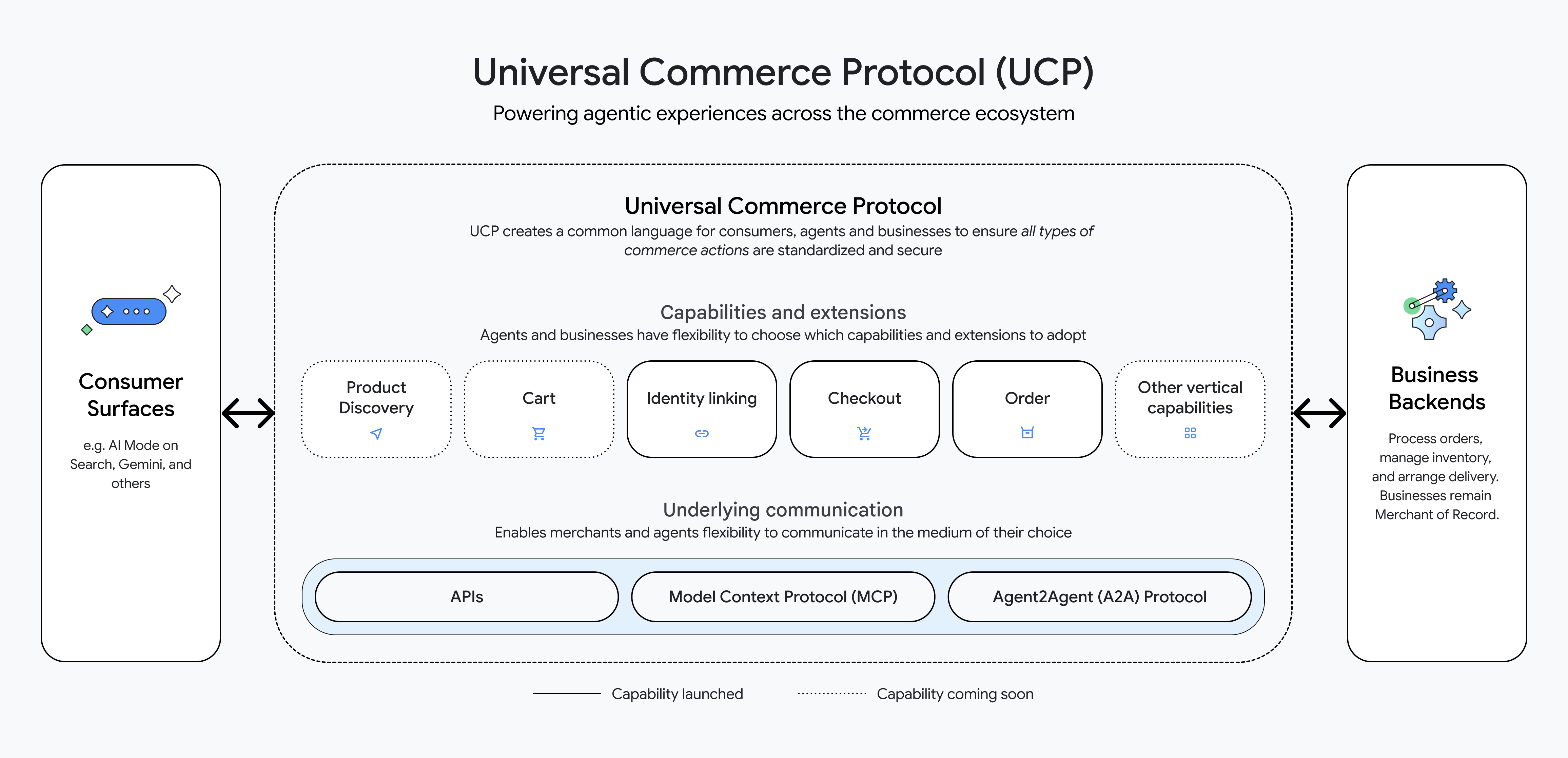
UCP is an open protocol that lets AI systems and merchant systems speak the same language.
It standardizes the full commerce flow:
Product discovery
Pricing and availability
Cart and checkout
Payments
Orders and fulfillment
An AI agent can ask a business:
“Is this in stock?”
“What’s the final price?”
“Can I place the order now?”
And the business can respond securely, in a structured way, without custom integrations for every platform.
The diagram above shows this clearly:
On the left, consumer surfaces like Search, Gemini, and other AI experiences
In the middle, UCP is acting as the common layer
On the right, business backends where inventory, orders, and delivery are handled
Merchants remain the “merchant of record” meaning that they keep control over payments, customers, and fulfillment.
Why Google is doing this now
AI is already good at helping people decide what to buy.
The friction has always been the last step; the fact that conversions still happen on websites designed for humans, not agents.
UCP removes that friction.
It enables:
Checkout directly inside AI experiences
Faster purchases at the moment of intent
Fewer drop-offs between decision and payment
This is not theoretical. Apparently, major payment providers like Shopify, Target, Wayfair, and Etsy are already involved.
What this means for SEO and e-commerce
Some purchases will complete without a traditional site visit
In certain cases, the decision and the transaction may happen inside an AI. That reduces reliance on the click as the only conversion path, not the value of being discoverable.
Product and commerce data become more operational
Availability, pricing, shipping rules, and fulfillment accuracy matter as much as content quality. Systems that are inconsistent or slow will simply not be selected.
Measurement will need adjustment
Attribution models built around sessions and pageviews will miss part of the picture. New signals will appear that sit closer to order execution than traffic.
Merchant control remains unchanged
Brands still own the transaction, customer relationship, and fulfillment logic. UCP standardizes access, it does not intermediate ownership.
Over time, this favors businesses that treat commerce infrastructure as a product
What to do now
You don’t need to integrate tomorrow. But you do need to prepare.
Clean up product feeds and inventory accuracy
Make sure checkout and fulfillment systems are API-ready
Start thinking beyond traffic and toward intent execution
Watch how AI shopping flows evolve inside Search and assistants
If your commerce stack is fragile, AI will expose it fast.
My take
This won’t change how everyone buys overnight, but is very relevant if you’re running mid-to-large e-commerce, marketplaces, or any business with structured catalogs, inventory, pricing, and checkout systems.
In some cases, the decision and the transaction will happen without a traditional site visit. In others, nothing changes. Both paths will exist in parallel.
Over time, this benefits businesses with accurate product data, stable pricing, and dependable fulfillment. Not because they are bigger or better, but because they are easier to work with at a system level.
Search still matters. Websites still matter. SEO is not dead 😂
But the line between discovery and purchase gets thinner; That’s the shift worth paying attention to.